

A patch can mark a hard-earned mile, a rally attended, a memorial, or a club affiliation. If you are searching for motorcycle club patch rules, start with one principle: club colors are earned identity, not a costume. The exact expectations vary by club and region. Respectful riders ask before wearing a design that could be mistaken for official colors.
A kutte is more than a piece of riding gear. Colors, rockers, placement, and symbols can carry identity and history. A design that looks harmless to one rider may communicate something very different to another.
Motorcycle club patch rules are not universal. Club colors are often treated as earned symbols, not generic decoration. The safest practice is to avoid copying a known club's colors, insignia, rockers, or territory references. If a design could be mistaken for an established club's colors, ask that club directly before wearing it.
This guide explains the common language behind motorcycle club patches while keeping an important distinction in view: background information is not permission. For the broader story behind patched vests and personal style, read our guide to motorcycle vest patches, culture, and the kutte. Then use the principles below to build gear that tells the truth about your own riding life.
What Do Motorcycle Club Patch Rules Say About Colors?
In motorcycle culture, colors generally means the set of patches a club member wears to identify the club and, in some settings, the member's place within it. That differs from a personal collection of rally patches, memorial patches, brand patches, or other designs chosen by an independent rider.
A Virginia Department of Criminal Justice Services training document uses the term when discussing patches associated with motorcycle clubs. It is useful background for terminology, but it is not an official rulebook for every club, region, or chapter. Club traditions are local and organization-specific. Read the Virginia motorcycle club training reference as context, not as authorization.
Colors communicate belonging
Club colors can communicate belonging, identity, chapter structure, and sometimes territory. The pieces work together. The central emblem, top rocker, bottom rocker, colors, lettering, and arrangement may all be part of an organization's identity. A similar combination can create confusion even when the wearer had no intention of making a claim.
That is the practical reason motorcycle club patch rules deserve care. A personal patch is closer to a favorite concert shirt or rally souvenir. Colors can function more like an organization's uniform. The visual language overlaps, but the social meaning may not. If a design includes a club name, chapter wording, a territory reference, or a recognizable emblem, ask before wearing it.
Why one online rulebook cannot settle every question
Expectations can differ between traditional motorcycle clubs, social clubs, riding clubs, and independent riders. They can also vary by state, region, chapter, event, and the club's own history. One group's practice should never be presented as a universal standard for another.
When you are unsure, do not rely on a product listing, a generic diagram, or another rider's vest as permission. Ask the relevant club or a knowledgeable local rider. Be direct about your intent, listen to the answer, and respect it. That approach prevents a small design choice from becoming a larger misunderstanding.
What Do One-Piece, Two-Piece, and Three-Piece Patches Mean?
Patch structure can tell an experienced rider how a club presents itself, but it is not a universal code with one meaning everywhere. A one-piece back patch, a two-piece set, and a three-piece set may carry different expectations depending on the organization and location. Treat these layouts as descriptive terms, not a checklist for copying club colors.
| Structure | Typical layout | What it may communicate | Use caution when |
|---|---|---|---|
| One-piece | One connected back patch | Group or club identity | The emblem resembles a known organization. |
| Two-piece | A main emblem with a separate supporting piece | Identity or organizational distinction | Wording and placement look official. |
| Three-piece | Top rocker, center insignia, and bottom rocker | Club name, emblem, and sometimes chapter or territory | The layout resembles established colors. |
How a three-piece set is usually arranged
The three-piece layout most often discussed in motorcycle club patch rules has a center patch between two curved rockers. The top rocker commonly displays a club name. The center patch carries an emblem or insignia. The bottom rocker may identify a chapter location or territory. The exact meaning and permissions remain specific to the club represented.
Rockers are not simply decorative arcs added to fill empty space. In combination with the center patch, they can identify an organization and connect it to a place. That is why a city, state, or territory reference deserves particular care. A homemade design can still be misread if its structure and language closely echo recognized colors.
What the number of pieces does not tell you
Counting pieces does not reveal every club's rules. A two-piece layout is not automatically safe, and a single patch is not automatically neutral. The design, wording, colors, emblem, territory reference, and setting all matter. If you belong to a club, follow its officers and established process. If you are independent, choose imagery that clearly reflects your own rides, interests, memories, or community.
What Is a 1% Patch, and Who Can Wear One?
A 1% patch is not a generic decoration for a motorcycle vest. In some club contexts, it carries a specific identity and should not be treated like a novelty graphic. The term is commonly explained through a historical account associated with an American Motorcyclist Association statement about the law-abiding majority of riders. The Virginia training reference discusses the symbol in the context of some outlaw motorcycle clubs.
That background does not create a universal definition. Motorcycle culture includes independent riders, social clubs, riding clubs, and traditional clubs with different histories and traditions. A number or percentage on a patch may have different meanings in different settings. Never assume that a symbol is available for personal use because it can be purchased online or because another rider wears it.
So who can wear a 1% patch? The safest answer is the person authorized by the club represented by the colors. That generally means an active member whose club has issued or approved the patch as part of its identity. A buyer, admirer, prospect, or riding companion should not assume that ownership of a patch creates permission to wear it.
The same principle applies to any recognizable club emblem, name rocker, chapter reference, or territory rocker. If you are unsure, ask the specific club before wearing it. If your goal is to show your own riding history, choose a rally, memorial, brand, achievement, or personal patch instead. Keep the design clearly individual, and do not present another group's identity as your own.
Where Do Rockers and Center Patches Go?
On a traditional three-piece set of motorcycle colors, placement is part of the message. The center patch sits between the two rockers on the back of a vest or cut. The top rocker commonly identifies the club. The center carries its emblem. The bottom rocker may identify a chapter location or territory. Together, those pieces form a single identity rather than three unrelated decorations.
The top rocker
A top rocker is the curved patch above the center design. It commonly displays a club name. A name rocker can communicate more than a favorite phrase when it is paired with a distinctive center emblem and a lower location rocker. Independent riders should avoid using a club title or club-like wording simply because it looks strong on the back of a vest.
The center patch
The center patch is the visual anchor of the arrangement. For club colors, its emblem works with the surrounding rockers and color scheme. For an independent rider, a center patch can still mark a meaningful rally, charity ride, personal nickname, or interest. The safer choice is an unmistakably personal design that does not resemble a known club's insignia.
The bottom rocker
A bottom rocker is the curved patch below the center. It can identify a chapter location or territory. Adding a city or regional reference beneath a club-style emblem deserves extra caution because it may look like an affiliation or territorial claim. Do not copy a layout from a diagram and assume the result is acceptable everywhere. Ask when there is doubt.
What Can Independent Riders Wear Without Club Affiliation?
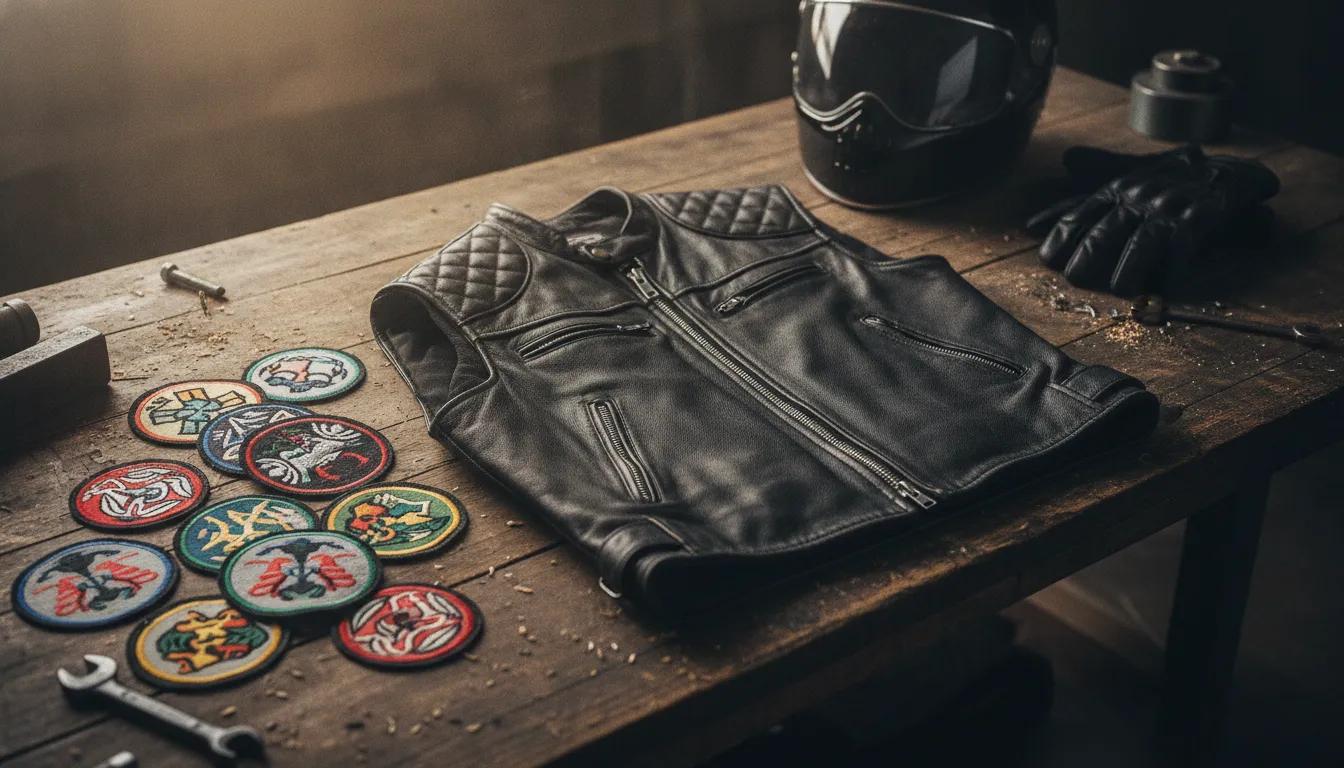
Independent riders have plenty of room to build a vest that tells a real story. Personal patches can represent a nickname, hometown, favorite rally, charity, service background, motorcycle brand, road trip, memorial, or interest. The key is making the difference between personal expression and club identification easy to understand.
Start with the reason each patch belongs on the vest. A rally patch can mark a place and a memory. A memorial patch can honor someone important. A brand or shop patch can show connection to a community. A personal design can reflect the way you ride. You do not need to fill every open panel. Empty leather can give the pieces you chose more room to speak.
Be more careful with a large center emblem paired with a curved top rocker and bottom rocker. The layout can read as club colors, especially when it includes a city, state, territory, number, or recognizable symbol. Keep personal patches visually separate from a three-piece arrangement when your intent is independent riding.
Hot Leathers carries designs in its biker patches collection and bases suited to personal riding gear in the motorcycle vest collection. Those products can help you build a personal look, but the same etiquette still applies to every patch, regardless of where it was purchased. Choose designs you can honestly claim and ask before wearing anything that could be mistaken for club colors.
How Do You Build a Kutte While Respecting Club Culture?
Building a kutte is part planning, part personal history, and part respect for the riders around you. Use these steps to create a vest that looks intentional without borrowing an identity that is not yours.
- Choose the base for your actual use. Start with a leather or denim vest that fits the way you ride and leaves enough room for the patches you truly want. If you want a club-style silhouette without club affiliation, keep the design personal and avoid copying a known color set. Compare options in the motorcycle club vest collection before deciding on the base.
- Write down the story behind the layout. List the rides, places, people, causes, and interests you want the vest to represent. This keeps the design grounded in your experience and helps you avoid adding a patch only because it looks tough. A vest with a clear story usually feels more authentic than one filled without a plan.
- Check symbols and wording. Look closely at names, rockers, numbers, territory references, colors, and recognizable emblems. Search for possible confusion before you attach anything. If a patch could be read as a club claim, set it aside and ask the relevant club or a knowledgeable local rider.
- Lay everything out before attaching it. Put the vest flat and position each patch without sewing or gluing. Photograph the arrangement, measure the spacing, and check it while wearing the vest. Make sure a patch that looks harmless by itself does not create a club-like pattern when combined with the others.
- Use durable attachment methods. Follow the patch maker's instructions and choose a method appropriate for the vest material. On leather, avoid rushing into holes or adhesives that could damage the panel. If you are sewing, use the practical guidance in this leather vest patch sewing guide and test your approach on a hidden area when possible.
- Ask before entering an unfamiliar setting. A rally, club event, or local riding area may have expectations you do not know. If the layout or symbol is questionable, ask ahead of time rather than relying on an assumption. Respectful questions are easier to handle than an accidental claim.
A kutte should carry your miles, memories, and identity. It should not imply membership you have not earned or permission you have not received. Take your time, keep the design unmistakably yours, and let the finished vest reflect the way you actually ride.
Shop patches for your personal kutte
Frequently Asked Questions
Are motorcycle club patch rules the same everywhere?
No. Expectations differ among traditional motorcycle clubs, social clubs, riding clubs, and independent riders. They can also vary by region, chapter, event, and organization. Treat online guides as background, not permission. Ask the relevant club directly when a design or layout could be mistaken for its colors.
What does a three-piece motorcycle patch mean?
A three-piece set commonly has a top rocker, center insignia, and bottom rocker. The top rocker may show a club name, while the bottom rocker can identify a chapter or territory. These are common descriptions, not a universal rulebook. The represented club decides what its colors mean and who may wear them.
Can independent riders wear patches on a cut?
Yes. Independent riders can use personal, rally, memorial, brand, charity, and interest patches to document their own riding life. Avoid club insignia, claimed territory, and layouts that closely imitate established three-piece colors. Make the design clearly personal. Ask questions before wearing it in an unfamiliar setting.
Where should a bottom rocker patch go?
In a traditional three-piece layout, the bottom rocker sits below the center patch and may signal a chapter location or territory. Do not add a place name simply because it fits the vest. Placement and wording can carry meaning, so confirm the layout with the club instead of treating a generic diagram as approval.
What should I do with club patches after leaving a club?
Do not assume you can keep wearing club colors after leaving. Club-specific patches and the cut may be treated as club property. Return or removal is handled according to that organization's rules. Contact the club or a former sponsor for the exact process. Stop wearing the colors until you have clear direction.
Shop motorcycle vests for your next ride
These motorcycle club patch rules are a starting point, not a substitute for the represented club's direction. Follow local guidance before you ride.
Respect matters on every mile.
End.