

How to care for a leather motorcycle jacket comes down to four habits: follow the care label, clean gently, condition sparingly, and store the jacket dry with room to breathe. Do that, and a good set of leathers can build character without turning stiff, cracked, or permanently stained. The routine below is made for riders who want their jacket ready for the next stretch of road, not just looking good on a hanger. If you are still choosing the right cut, start with Hot Leathers' Motorcycle Leather Jackets and Vests: The Rider's Buying Guide.
Shop leather motorcycle jackets
Why Leather Care Is the Difference Between 2 Years and 20
Leather is durable, but durable does not mean maintenance-free. Road dust, bug residue, sweat, rain, salt, ultraviolet light, and friction all work on the hide and its finish. The goal of care is not to make a jacket look brand new forever. It is to remove grit before it grinds into the surface, replace some of what cleaning removes, and prevent damp storage from creating a bigger problem.
Leather Naturally describes leather as a hardwearing natural material that benefits from regular maintenance. Its basic care sequence is simple: clean, condition, and protect. That sequence is useful for motorcycle gear, with one important addition: the jacket's own care label comes first. A jacket may combine finished leather with printed panels, stretch fabric, armor pockets, quilted lining, or other materials that need different treatment. For Hot Leathers riders, that care routine complements the buying fundamentals covered in the rider's buying guide, rather than replacing them.
Start with the jacket, not the cleaner
- Read the sewn-in care label and any instructions supplied with the jacket.
- Remove the thermal or waterproof liner if the instructions allow it, then clean the liner separately.
- Remove armor only if the jacket design and care instructions permit it.
- Zip pockets and close snaps before handling the jacket.
- Test any cleaner or conditioner on a hidden section first.
A cleaner that works on one finish can darken another. If you are unsure what finish or hide you have, stop at a dry cloth and ask the jacket maker or a qualified leather professional before applying a product over the entire garment.
How Often Should You Condition Your Leather Motorcycle Jacket?
Condition a leather motorcycle jacket when the hide looks dry, feels stiff, or has gone through repeated wet, dirty, or high-sun rides. For many regular riders, that means a light conditioning session a few times per riding season, not a heavy coating every week. Use the jacket's condition as the guide, because mileage, climate, finish, and storage matter more than a calendar alone.
Clean the jacket before conditioning it. Conditioner applied over road grit can hold that grit against the leather. After cleaning, let the jacket dry completely at room temperature. It should feel cool and dry to the touch before you apply anything.
A practical conditioning schedule
| Riding and storage pattern | What to do | What to watch for |
|---|---|---|
| Occasional rides in a dry climate | Dust and wipe after rides; condition when the leather loses its supple feel. | Dry cuffs, collar, shoulders, and creases. |
| Frequent rides, rain, sweat, or road salt | Wipe down more often and inspect the finish after wet rides; condition after a full clean and complete dry. | Stiffness, salt marks, dull patches, or cracking. |
| Long off-season storage | Clean, condition lightly, and confirm the jacket is fully dry before covering it. | Musty odor, mildew, flattened shoulders, or trapped moisture. |
More conditioner is not better. Excess product can leave a greasy film that attracts dust, soften areas that need structure, and transfer onto clothing. A thin, even application is easier to control than one heavy coat. Let it absorb, then buff away what remains on the surface.
What Leather Conditioner Should You Use, and What Should You Avoid?
Choose a leather conditioner made for the jacket's finish, apply it to a cloth rather than pouring it directly onto the hide, and test it in an unseen area first. Avoid household cleaners, harsh solvents, abrasive products, and any product the jacket maker says not to use. The right product is the one that matches the leather, not the one with the loudest promise on the label.
Leather Naturally separates pigmented, aniline, nubuck, and suede leathers because they absorb and respond to products differently. Pigmented leather, common in motorcycle apparel, has a protective finish. Open-pore or unfinished leather is more absorbent and can darken when treated. A motorcycle jacket with a distressed, printed, perforated, suede, nubuck, or mixed-material panel needs extra caution.
Use this product decision guide
| Jacket surface | Safer starting point | Do not assume |
|---|---|---|
| Finished or pigmented leather | Leather-specific cleaner and conditioner, used sparingly after a patch test. | That a household soap, furniture polish, or shoe product is compatible. |
| Perforated leather or printed panels | Minimal moisture and a soft cloth; follow the product-specific instructions. | That soaking or scrubbing will not affect holes, color, or graphics. |
| Suede or nubuck | A dedicated brush or product made for that nap, tested out of sight. | That a standard smooth-leather conditioner is safe. |
| Unfinished or aniline leather | Maker-approved care or professional advice before using liquid products. | That water-based cleaning will not change the color or create a mark. |
The Leather Institute advises against high-pH cleaners, abrasives, alcohol, strong solvents, furniture polish, glass cleaner, and dish detergent for leather care. Its guide also recommends applying care products to a cloth and using controlled, light application. That is a sound approach for a jacket: keep the product on the cloth, keep moisture low, and stop if the color or finish reacts unexpectedly.
Do not confuse waterproofing with conditioning. A protectant may add water resistance, while a conditioner is intended to replenish the feel of dry leather. Use either only when it is appropriate for the finish, and follow the product directions rather than layering several products at once.
Find a leather jacket built for your next ride
How Do You Clean Road Grime and Rain Stains Without Damaging the Hide?
To clean a leather motorcycle jacket, remove loose grit with a dry microfiber cloth, spot clean with a small amount of leather-safe cleaner, wipe away residue, and let the jacket air dry away from heat and direct sun. Never machine wash, wring, or saturate a leather jacket unless its maker specifically says otherwise. Gentle repetition beats one aggressive scrub.
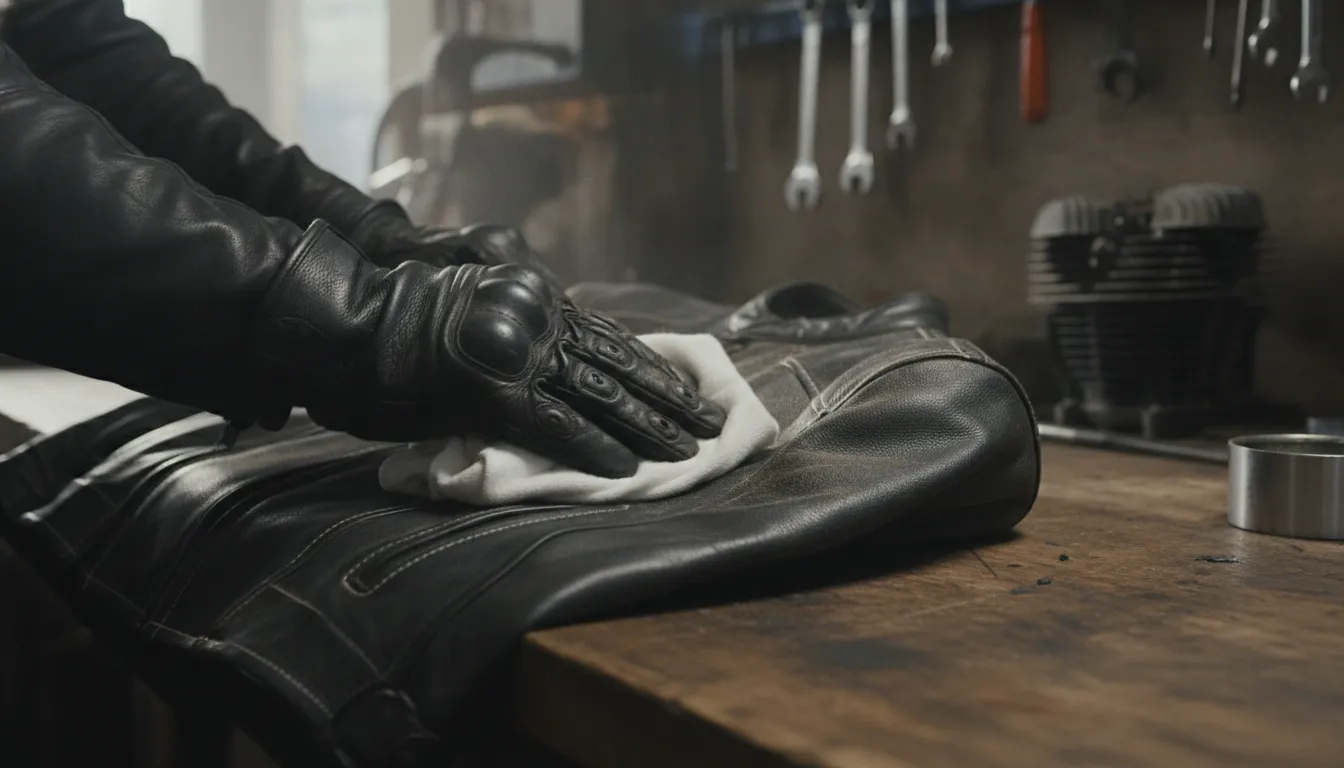
Six steps for a routine clean
- Check the label. Confirm whether the jacket has removable liners, special panels, or restrictions on wet cleaning.
- Remove loose dirt. Use a dry, soft cloth to lift dust and grit before adding moisture. Pay attention to cuffs, the collar, pocket openings, and seams.
- Patch test. Apply a small amount of leather-specific cleaner to a hidden area. Give it time to show whether it darkens, dulls, or transfers color.
- Spot clean in sections. Put the cleaner on the cloth, not directly on the jacket. Work lightly over the dirty area and avoid soaking seams, perforations, zippers, and printed graphics.
- Remove residue. Use a separate cloth that is barely damp, then blot with a dry cloth. Do not scrub harder because a mark is not disappearing immediately.
- Air dry completely. Hang the jacket on a broad, supportive hanger in a cool, ventilated room. Keep it away from radiators, hairdryers, fireplaces, and direct sunlight.
What to do about common road stains
- Road dust: Let the jacket dry, brush or wipe off the loose material, then spot clean the remaining film.
- Bug residue: Soften it with a slightly damp cloth and repeat gently. Do not attack it with a rough sponge or fingernail.
- Rain or road salt: Blot rather than rub. Wipe away residue with minimal moisture and allow a full natural dry before conditioning.
- Oil or grease: Do not spread it by rubbing. Blot the surface and consult the jacket maker or a leather professional if the mark remains.
- Mildew: Separate the jacket from other gear, move it to a ventilated area, and get professional advice for a serious or recurring growth problem.
Leather Naturally recommends natural drying away from direct heat and sunlight, and a hidden-area test before using a treatment. Those two rules prevent many of the most difficult care mistakes. If the jacket has been soaked through, smells musty, or has a finish that is already flaking, skip home experimentation and ask a qualified leather repair professional what can be saved.
How Should You Store a Leather Motorcycle Jacket in the Off-Season?
Store a leather motorcycle jacket clean, fully dry, supported by a wide hanger, and covered with breathable fabric in a cool, dry place. Do not seal leather in a plastic garment bag, leave it bunched on the floor, or put it beside a heater. Good storage protects the shape as well as the hide.
- Clean off road grime before the final storage day.
- Condition lightly only after the jacket is fully dry.
- Use a wide, padded, or otherwise supportive hanger so the shoulders do not collapse.
- Leave room around the jacket for airflow.
- Use a breathable garment cover instead of sealed plastic.
- Keep it out of direct sunlight and away from heat, damp basements, and vehicle trunks.
- Check it midway through a long storage period for odor, dampness, mildew, or pests.
If the jacket gets caught in rain, do not rush it toward a heat source. Hang it properly, open the zippers and pockets, and let it dry at room temperature. Once it is completely dry, inspect the finish before deciding whether it needs a light conditioning pass.
When Should You Repair a Leather Jacket Instead of Replacing It?
Repair a leather motorcycle jacket when the damage is limited to a seam, zipper, snap, lining, or manageable surface issue and the main hide is still sound. Replace or professionally assess it when the leather is badly cracked, the structure has been compromised, or the jacket has damage that could affect its intended riding use. Appearance alone does not tell you whether a garment is still fit for the road.
Repair may make sense when you see:
- A loose stitch or open seam that has not pulled through the leather.
- A broken zipper slider, snap, or buckle that can be replaced.
- A damaged lining or pocket bag with solid outer leather.
- A small surface scuff that does not expose or split the hide.
- Dry areas that improve after correct cleaning and light conditioning.
Ask for a professional assessment when you see:
- Deep cracks, brittle leather, major tears, or panels that are separating.
- Extensive mold, chemical exposure, or a strong odor that returns after ventilation.
- Damage after a crash, especially around seams, shoulders, elbows, or other high-stress areas.
- Color transfer or finish failure that spreads when you wipe it.
Leather can often be repaired, but a repair decision should consider the jacket's construction and purpose, not just its sentimental value. If you rely on a jacket as riding gear, do not treat a cosmetic fix as proof that it still offers the same coverage or protection. Follow the maker's guidance and replace any component that the manufacturer identifies as compromised.
Shop Hot Leathers leather motorcycle jackets
Leather Motorcycle Jacket Care FAQs
Q: Can you wash a leather motorcycle jacket in a washing machine?
A: Usually no. Check the care label first, but most leather motorcycle jackets should be cleaned by hand with low moisture. Machine agitation, soaking, and heat can distort the hide, lining, finish, and hardware.
Q: Can I use saddle soap or household soap on motorcycle leather?
A: Do not assume it is safe. Use a cleaner made for the jacket's leather finish and follow the maker's instructions. Strong household cleaners, dish detergent, abrasives, alcohol, and solvents can damage a leather finish.
Q: How long should a leather motorcycle jacket dry after cleaning?
A: Let it dry naturally until it is completely cool and dry to the touch. The time depends on how much moisture was used, the leather thickness, lining, humidity, and airflow. Do not speed the process with a radiator, hairdryer, or direct sun.
Q: Can I condition suede, nubuck, or unfinished leather like smooth leather?
A: No. Suede, nubuck, and unfinished or aniline leather can react differently and may darken or mark. Use a product made for that specific surface, test it in a hidden spot, or ask a leather professional before treating the jacket.
Q: What is the best way to store a leather motorcycle jacket?
A: Store it clean and fully dry on a wide hanger in a cool, dry, ventilated place. Use a breathable cover, avoid sealed plastic and direct heat, and check the jacket during a long off-season so moisture or mildew does not go unnoticed.
A leather jacket earns its place in a rider's gear rotation one ride at a time. Wipe off the road, condition only when the hide needs it, dry it naturally, and give it a proper place to hang. That simple routine keeps your leathers looking better and leaves you more time for the part that matters: getting back on the road.
Care guidance is general information. Always follow the care label and the manufacturer's instructions for your specific jacket, leather finish, liner, and protective components.
Sources: Leather Naturally leather care guide; The Leather Institute care and cleaning guide.